
If your morning coffee feels incomplete without a digital puzzle, you aren’t alone. Since the 2021 boom, the New York Times Games division has dominated this space with habit-forming heavyweights like Wordle, Connections, and Spelling Bee.
However, in parallel to this corporate monolith, a thriving indie scene exists. Leading the pack is Waffle, a brilliant, logic-based letter-swapping game built entirely on organic word-of-mouth.
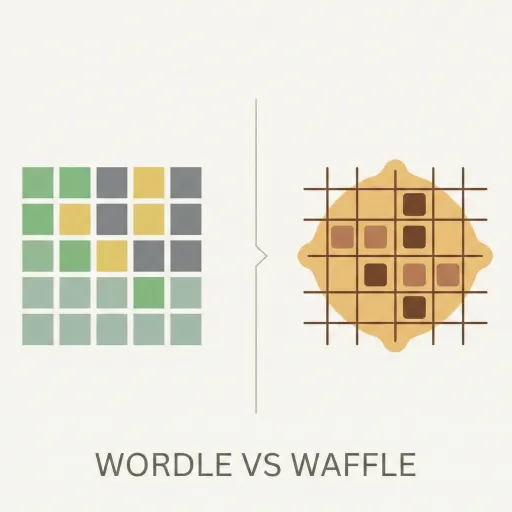
As a gaming strategist and daily puzzle enthusiast, I’ve spent years analyzing the mechanics, search trends, and player psychology behind these games. Today, we’re putting the Waffle daily word game head-to-head with the daily Wordle and its NYT siblings to see which truly deserves your time.
Table of Contents
Gameplay Mechanics: Guessing vs. Swapping
To understand why players are searching for the waffle game in droves (over 246,000 monthly searches!), we have to look at how these games test your brain.
- Wordle (The Process of Elimination): You have six guesses to find a hidden five-letter word. It tests vocabulary and logic but relies heavily on luck, often leaving players guessing unthinkingly between similar-sounding words.
- Waffle (Deterministic Logic): The waffle word game gives you all the letters upfront in a scrambled 5×5 grid shaped like a breakfast waffle. Rather than guessing, you use 15 swaps to arrange intersecting words, mathematically designed to be solved in exactly 10.
- Connections (Lateral Thinking): This NYT game shifts focus to cultural literacy. You must group 16 words into four hidden categories, relying heavily on navigating highly subjective semantic traps.
- Spelling Bee (Mental Stamina): A test of lexical endurance where you build as many words as possible from a honeycomb of seven letters.
The Verdict: While Wordle tests what words you know, Waffle tests how well you can spatially organize them. Waffle removes the frustration of “vocabulary luck” entirely.
Difficulty Paradigms: Managing the Morning Frustration
The satisfaction of a daily puzzle depends on its difficulty curve.
Wordle and Connections are highly volatile. Wordle relies on lucky starting words, while Connections hinges on recognizing highly subjective trivia that can guarantee failure if missed.
Waffle operates on mathematical objectivity. Completing the puzzle is highly achievable thanks to 5 generous buffer moves. The true master’s challenge is achieving a “perfect” 5-star rating by finishing in exactly 10 swaps, ensuring you never walk away feeling cheated by obscure trivia.
Replayability: The Paywall vs. Waffle Unlimited
The biggest divergence between the NYT ecosystem and indie titles is accessibility.
The New York Times uses its games to drive digital subscriptions. Want to play past Wordles or finish a Spelling Bee board after hitting a certain rank? You hit a strict paywall.
Waffle Studio takes a radically different approach. Understanding that puzzle lovers want more, they offer the historical Waffle Archive for free. This waffle game unlimited philosophy respects the user. Furthermore, massive search volume for terms like “unblocked waffle” proves players are easily bypassing restrictions to access Waffle on strict corporate or school networks.
And for those who master the standard grid and crave an even deeper cognitive workout, stepping up to Deluxe Waffle Unlimited provides an expanded, high-stakes spatial puzzle without any subscription barriers.
Expert Strategy: How to Get 5 Stars in Waffle
If you are transitioning from Wordle to Waffle, you need to shift your cognitive approach. Here is how I consistently secure a 5-star rating:
- Anchor the Greens: Green tiles are already in their correct final position. Never move them, and build your strategy around these structural anchors.
- Hunt for Double Swaps: The golden rule of the waffle word game. Swap two letters where both land in their correct green spots simultaneously for maximum efficiency.
- Prioritize Intersections: The corner squares where vertical and horizontal words meet are the most valuable real estate. Solving an intersection perfectly fixes two words at once.
- Solve Mentally First: The ultimate pro tip. Don’t touch a single tile until you have visually unscrambled the words from waffle in your head.
Frequently Asked Questions
Is the Waffle game owned by the New York Times?
No. Despite high search volume for terms like waffle nyt“and visual similarities to Wordle, Waffle is an independent game created by developer James Robinson and published by Waffle Studio. The New York Times Games division has never acquired it.
What is the difference between Wordle and Waffle?
Wordle is a guessing game based on vocabulary recall and elimination. Waffle is a spatial logic puzzle where all the correct letters are already provided on the board, and you must drag and drop them to unscramble intersecting words.
How do I get 5 stars on the Waffle daily word game?
To achieve a perfect 5-star rating, you must solve the puzzle in exactly 10 swaps. The best strategy is never to move the green tiles, prioritize solving the corner intersections first, and look for “double swaps” where two letters land in their correct spots simultaneously.
Can I play past Waffle games for free?
Yes. Unlike the New York Times, which puts its puzzle archives behind a paywall, Waffle Studio offers a Waffle Unlimited feature that lets players access and play the complete historical archive of past puzzles for free.
What is Deluxe Waffle?
Deluxe Waffle is a larger, more challenging version of the standard game released every Monday. It features an expanded grid requiring players to unscramble eight intersecting words instead of the usual six, offering a deeper test of spatial reasoning.
A Balanced Puzzle Diet
It is no longer a zero-sum game where you must choose just one app. The best cognitive routines leverage different logic engines to exercise different parts of the brain.
The NYT suite provides excellent tests of vocabulary recall and trivia. However, if you are tired of the statistical luck of Wordle or aggressive paywalls, the Waffle daily word game is the ultimate counterweight. By transforming the color-coded grid into a spatial logic puzzle, it replaces the anxiety of blind guessing with deep, deterministic satisfaction.
Add Waffle to your morning rotation—your brain will thank you.